
Paying rent is a major challenge for many low-income families in the United States. When most of a paycheck goes toward housing, there may be little left for groceries, utility bills, transportation or medical expenses. Section 8 housing vouchers help eligible families by covering part of their rent.
The Housing Choice Voucher Program is funded by the federal government and run locally by public housing agencies (PHAs). It lets eligible households rent qualifying homes from private landlords while paying a portion of the housing costs themselves.
This guide explains the main benefits, shows with worked examples how your share of the rent is calculated, and covers eligibility, applying, waitlists, limits and proposed rule changes. It is general information only. Your local housing agency makes the final decisions about your case.
| Key TakeawaysA voucher pays part of your rent directly to your landlord. You pay the rest, usually about 30% of your adjusted monthly income.You can use a voucher in privately owned rental housing, as long as the landlord participates and the unit passes inspection and rent approval.The actual amount you pay depends on your income, deductions, utility allowances, minimum rent and your local payment standard.Income generally must not exceed 50% of your area’s median, and housing agencies must give 75% of their vouchers to applicants at or below 30% of the median.Apply only through your local housing agency. Waitlists are often long or closed, so apply to more than one if you can.Rules can vary by agency and may change. Confirm details with your housing agency before you sign a lease. |
What Is a Section 8 Voucher?
“Section 8” is the common name for the Housing Choice Voucher Program run by the U.S. Department of Housing and Urban Development (HUD). Instead of living in a government-owned building, a voucher holder finds a rental home on the private market. The housing agency then pays a monthly subsidy directly to the landlord, and the family pays the difference.
Vouchers are different from public housing, where the government or a housing authority owns the building. They are also different from project-based assistance, which is tied to a specific property rather than to the family.
Main Benefits of Section 8 Vouchers
Lower Monthly Rent Payments
The biggest benefit is a lower rent bill. A household’s share of the rent is generally calculated using its income and program rules, and in many cases it is about 30% of adjusted monthly income. The housing agency pays its portion directly to the landlord.
Lower rent can leave more money for everyday needs. Parents may find it easier to pay for groceries, school supplies, childcare and transportation without falling behind on other bills. Even a few hundred dollars in monthly savings can make household finances easier to manage.
Access to Private Rental Housing and More Choice
A voucher lets eligible families search the private rental market instead of being limited to public housing developments. Depending on local availability, that may include apartments, townhouses or single-family homes. Families can weigh distance from work, school quality, public transportation and access to healthcare when choosing where to live.
For example, a parent who works full-time may want a home close to work and their child’s school. Without help, that location might be too expensive. A voucher could make it affordable if the property and the rent meet program requirements.
Greater Housing Stability
When rent takes up most of a family’s income, an unexpected expense such as a car repair, a medical bill or reduced work hours can quickly become a housing problem. Lowering the family’s share of the rent can leave more room in the budget to handle surprises and keep up with other bills.
Staying in one home can also help children keep the same school, friends and daily routine, and can make it easier for parents to manage work schedules and childcare.
The Ability to Move with Your Voucher
Eligible families may be able to move to another part of the country and keep their assistance. This is called portability. According to HUD, a family that lived in the issuing agency’s area when it applied can generally move with its voucher. Otherwise, it may have to lease within that area for the first 12 months. Moving requires notifying your current agency and following its procedures, and the receiving agency’s rules apply.
Portability applies to tenant-based vouchers, which you can use in different homes. With a project-based voucher, the assistance is tied to the specific unit, so it stays with that unit if you leave.
How Much Rent Will You Pay?
There is no single rent amount for every Section 8 household. Your share depends on your income, allowed deductions, utility allowances, any minimum rent and the local payment standard.
The Basic Formula
Your required contribution is called the Total Tenant Payment. It is generally the highest of these amounts: 30% of your monthly adjusted income, 10% of your monthly gross income, welfare rent designated for housing (where it applies), or your housing agency’s minimum rent, which can be set up to $50. For most households with ordinary earnings, the 30% of adjusted income figure is the one that applies.
The housing agency’s subsidy, called the housing assistance payment, is generally the lower of the payment standard or the unit’s gross rent, minus your Total Tenant Payment. The payment standard is set by the agency, usually between 90% and 110% of HUD’s fair market rent for the unit size in your area.
Subsidy = lower of (payment standard, gross rent) − Total Tenant Payment
Worked Example 1: Rent Above the Payment Standard
A household has gross income of $1,800 a month and adjusted income of $1,500. The rent is $1,200 with utilities included, and the local payment standard is $1,100. The numbers below are illustrative only.
| Item | Amount |
|---|---|
| Total Tenant Payment (30% of $1,500 adjusted income) | $450 |
| Lower of payment standard ($1,100) or rent ($1,200) | $1,100 |
| Housing agency subsidy ($1,100 − $450) | $650 |
| Family pays the landlord ($1,200 − $650) | $550 |
The family pays $550, not $450, because the rent is $100 above the payment standard and the family covers the difference. Under HUD rules, a family’s share generally can’t go above 40% of its adjusted monthly income when it first leases a unit or moves to a new one. Here, 40% of $1,500 is $600, so $550 is within that limit.
Worked Example 2: When You Pay Your Own Utilities
Now suppose the landlord charges $1,000 in rent and the tenant pays heat and water separately. The agency applies a $100 utility allowance, which is added to the rent to get the gross rent. The payment standard is $1,100.
| Item | Amount |
|---|---|
| Gross rent ($1,000 rent + $100 utility allowance) | $1,100 |
| Subsidy ($1,100 − $450 Total Tenant Payment) | $650 |
| Family pays the landlord ($1,000 − $650) | $350 |
| Family pays its own utilities (about) | $100 |
| Family’s total housing cost | $450 |
The utility allowance is an estimate set by the housing agency, not your actual bill. If your real utility costs are higher than the allowance, you pay the difference.
Quick Starting Estimate
If you only want a rough idea of the 30% figure, use this table. It is a starting point, not an official rent determination, and the agency’s calculation may differ.
| Adjusted monthly income | 30% starting estimate |
|---|---|
| $1,000 | $300 |
| $1,500 | $450 |
| $2,000 | $600 |
| $2,500 | $750 |
Before you sign a lease, ask your housing agency to calculate your expected share of the rent for the specific unit. This helps you avoid surprises after you move in.
How the Money Flows
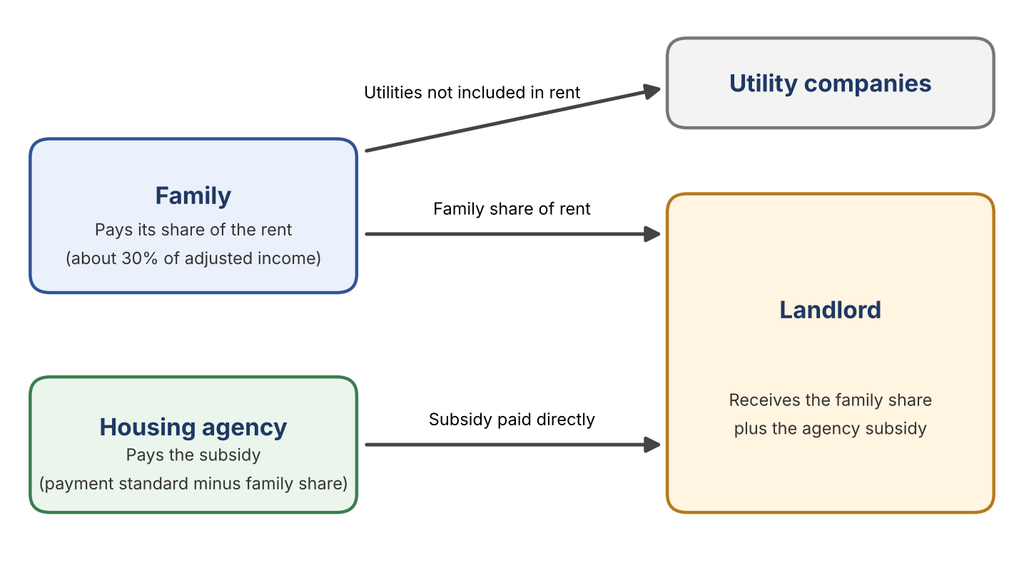
| Who | Pays | To |
|---|---|---|
| Family | Its share of the rent, and any amount above the payment standard | Landlord |
| Housing agency | The housing assistance payment (subsidy) | Landlord (directly) |
| Family | Utilities that are not included in the rent | Utility companies |
Do Section 8 Vouchers Cover Utilities?
Not automatically. A voucher does not pay your household bills. When you pay some utilities yourself, the housing agency applies a utility allowance, which lowers the rent you pay your landlord (as shown in Example 2). You are still responsible for the actual utility bills.
Utilities can change what a home really costs. Imagine two apartments. One rents for $1,200 with heating and water included. The other rents for $1,100, but the tenant pays heating and water, which might average $180 a month. The second apartment could cost more each month even though the advertised rent is lower. Always ask the landlord which utilities are included, and ask your housing agency how the allowance applies.
Who Qualifies for Section 8?
Eligibility depends mainly on household income, family size and where you live. HUD sets income limits for each area. Under HUD’s fact sheet, a family’s income generally may not exceed 50% of the median income for the county or metropolitan area where it wants to live. Housing agencies must also give 75% of their vouchers to applicants whose income is at or below 30% of the area median, so families with the lowest incomes are served first.
| Income Limits at a GlanceUp to 50% of area median income: the general limit for a family to qualify.Up to 30% of area median income: 75% of an agency’s vouchers must go to families at or below this level.Limits vary: they depend on your county and household size, and HUD updates them each year. Look up your area’s figures on HUD’s income limits page, or ask your housing agency.Some sources describe different limits for certain families, such as those who were displaced. Ask your agency whether any exceptions apply to you. |
Other requirements usually include:
- Being a U.S. citizen or an eligible non-citizen.
- Providing a valid Social Security number for the head of household, as required by the program.
- Passing the housing agency’s screening, which may include a review of rental and criminal history under the agency’s policies.
Local Preferences
Each housing agency decides its own preferences based on local needs, and families who qualify for a preference are moved ahead of those who don’t. According to HUD, examples include families who are homeless or living in substandard housing, families paying more than 50% of their income for rent, and families who have been involuntarily displaced. Some agencies also give preference to veterans, people with disabilities or local residents. Because these rules are local, read each agency’s policy before you apply.
HUD also notes that some crimes may make an applicant ineligible, and that an agency may close its waitlist when demand exceeds what it can assist soon.
How to Apply and How Waitlists Work
You apply through your local public housing agency. HUD directs applicants to find their agency through its Public Housing Agency Directory. In many areas, demand is much larger than the number of vouchers, so waitlists are often closed, open only for short periods, or filled by lottery.
- Find the housing agencies that serve your area, and consider nearby areas too.
- Check whether each agency’s waitlist is open and how it selects applicants (by date, lottery or preference).
- Apply during the open period and gather your documents (IDs, income proof, household information).
- Keep your contact details current, because agencies may remove applicants who don’t respond.
- Respond to eligibility interviews and requests for information on time.
| Watch Out for ScamsYou should not need to pay anyone to submit an application or to move up a waitlist. Be cautious of websites or callers who ask for fees or promise guaranteed approval.Go directly to your local housing agency or HUD to apply, and check that any website you use is an official government or housing agency site. |
How to Use Your Voucher
Once you are selected and approved, you receive a voucher and a limited time to find a home. HUD says the initial search period is at least 60 days, and the agency sets the exact period. If you can’t find a unit in time, you can ask for an extension.
- Receive a voucher: The household must be selected and approved for assistance.
- Find a rental property: Search within the program’s requirements and your deadline.
- Submit the rental details: The housing agency reviews the proposed rent and tenancy information.
- Complete the inspection and approval: The property must meet housing quality standards, and the rent must be approved as reasonable.
- Sign the lease: Once approved, you pay your required share, and the housing agency pays its portion to the landlord.
Not every landlord accepts vouchers, and not every property qualifies. Federal law does not generally require landlords to accept vouchers, although some states and cities prohibit refusing a tenant because of the source of their income. Confirm that a home can be approved before you make moving arrangements or pay nonrefundable fees. Some agencies also expect tenants to pay their own security deposit.
Rules Vary by Where You Live
Section 8 is a federal program, but it is run locally, so the details you face depend on your housing agency, county and state. These are the main things that differ:
- Waitlist rules: whether the list is open, how applicants are chosen and which local preferences apply.
- Payment standards: the maximum subsidy, set between 90% and 110% of HUD’s fair market rent for your area and unit size.
- Minimum rent and utility allowances: set by your agency.
- Landlord laws: some states and cities prohibit refusing a tenant because they use a voucher, while others do not.
- Moving: you must follow the receiving agency’s rules if you transfer your voucher to another area.
To find your agency, use HUD’s Public Housing Agency directory, then check that agency’s website or call it for its current waitlist status and local policies. Because limits and procedures change, always rely on your own agency’s current information.
Keeping Your Voucher: Recertification and Program Rules
A voucher is not permanent. Participants have an annual review of income and household makeup to confirm they remain eligible, and your share of the rent can change as your income changes. You must also report certain changes, such as changes in income or household members, when your housing agency requires it.
A voucher can be ended for serious violations, including breaking lease terms, not reporting income or providing false information. If your agency denies or ends your assistance, you generally have the right to ask for a review or hearing, so keep every notice and respond before the deadline.
Limits and Challenges of Section 8
- Long waitlists: In many areas, applicants wait months or years, and some lists are closed for long periods.
- Landlord participation: Not every landlord accepts vouchers, which can limit where you can live.
- Time limits and inspections: You have a limited time to find a unit, and the home must pass inspection and rent approval.
- Rent above the payment standard: You pay the difference if you choose a more expensive unit, within program limits.
- Ongoing requirements: You must complete annual reviews, report changes and follow the lease and program rules.
- Rules that vary locally: Payment standards, preferences and procedures differ from one agency to another.
Proposed Changes to HUD Housing Programs
Federal housing policy can change. According to reporting by the National Association of Realtors, HUD published two proposed rules in early 2026. One would let housing agencies and owners choose to adopt work requirements and time limits, of at least two years, for non-elderly, non-disabled households in programs that include vouchers. The other would bar households that include both eligible and ineligible members from receiving assistance, ending the prorated assistance those households can receive now.
Those reports described both as proposals open for public comment. This guide could not confirm whether either has been finalized or changed. Check HUD’s website and your local housing agency for the current status before you make decisions.
Frequently Asked Questions
Does Section 8 pay my whole rent?
No. The voucher pays part of the rent directly to your landlord, and you pay the rest. Your share is generally about 30% of your adjusted income, but it can be higher if the rent is above the payment standard or a minimum rent applies.
How long do I have to find a home with my voucher?
HUD says the initial search period is at least 60 days, and your housing agency sets the actual time. You can request an extension if you can’t find a unit in time.
Can I use a voucher for a house instead of an apartment?
Often yes, if the landlord agrees to participate, the home passes the housing quality inspection and the rent is approved. Availability depends on your local market.
Can I move to another city or state with my voucher?
Possibly. This is called portability. Rules depend on where you lived when you applied and on the receiving agency’s policies. Contact your current agency before you move.
Can a landlord refuse to accept my voucher?
Federal law does not generally require landlords to accept vouchers. Some states and cities have laws against refusing tenants because they use a voucher, so check the rules where you live.
How often do I have to recertify?
Participants have an annual review of income and household composition. You may also have to report changes between reviews, depending on your agency’s rules.
Is there a fee to apply?
You should not have to pay anyone to submit an application or move up a waitlist. Apply through your local housing agency and be careful with sites that ask for money.
Next Steps
Understanding the details before you start searching can help you find a home that fits your budget. Work through these steps:
- Find your local housing agency using HUD’s Public Housing Agency Directory.
- Ask whether the waitlist is open, how applicants are selected and what documents you need.
- Look up the income limits for your county and household size.
- Apply to more than one agency if you can, and keep your contact information current.
- Once you have a voucher, ask the agency to estimate your share of the rent before you sign a lease.
- Ask each landlord which utilities are included and whether they accept vouchers.
| Important NoteThis article is for general information only and is not legal, financial or government advice. We are not a government agency. Rules, income limits and payment standards change and differ by location, so always confirm details with your local public housing agency or HUD. This guide is reviewed regularly and updated when HUD or housing agencies change their rules. |
Sources
- HUD: Housing Choice Vouchers (information for tenants)
- HUD: Housing Choice Vouchers fact sheet (copy hosted by the City of Central Falls, RI)
- Technical Assistance Collaborative: Section 8 Management, Chapter 6 (Tenant Payment and HCV Subsidy)
- National Association of Realtors: HUD Proposes Changes to Assisted Housing Programs





Daniyal Khatri, ACCA, is a finance and audit professional with over 10 years of experience in accounting, audit, and financial reporting, including work with international clients in remote accounting roles. He specializes in IFRS-based reporting, audit documentation, financial statement analysis, and corporate governance, and focuses on simplifying complex finance concepts into practical, easy-to-understand content for students and professionals.